Sleep: The Essential Pillar of Health
I’ve decided to feature this blog post under Rough North’s Mind compass, but sleep contributes equally to Body, People, and even Planet. Without this essential pillar of health, we’re unable to function at our best. Sleep deprivation compromises our cognitive capacity, leaves our bodies feeling fatigued and sluggish, frays our interactions with others, and makes it much harder to summon the kind of motivation needed to make any kind of sustainable choices for ourselves, let alone for the planet.
While some people suffer from sleep disorders such as insomnia, sleep apnea, or restless leg syndrome, many of us unknowingly disrupt our sleep through our everyday habits. Substances like alcohol and caffeine can interfere with our rest, as can the temptation of “just one more episode” on Netflix or a quick five-minute scroll through our phones that turns into fifty. Life itself can also get in the way, and stress and anxiety are common culprits behind restless nights.
Whatever it is that robs you of your precious shut-eye, this blog post aims to share insights on just how vital sleep truly is and how you can reclaim it. Many of these takeaways come from Dr. Matthew Walker, often referred to as the world’s leading sleep expert. A Professor of Neuroscience and Psychology at the University of California, Berkeley, Dr. Walker has spent over 20 years studying the science of sleep. His work, including his bestselling book Why We Sleep: The New Science of Sleep and Dreams and his appearance on The Diary of a CEO podcast, offers a fascinating look at why sleep is the foundation of health.
Hopefully, these insights and tips will help you improve your sleep and settle down for a more restorative kip.

How Sleep Regularity Predicts Life Expectancy
Sleep is essential for overall health, yet it’s often underestimated. It’s more than a nightly recharge; it’s central to every aspect of our well-being, from DNA repair to toxin removal in the brain.
Dr. Walker explains that sleep plays a crucial role in flushing out metabolic toxins, including those associated with Alzheimer’s disease. Sleep deprivation doesn’t just leave you feeling groggy, it distorts the activity of 711 genes, impairing immune function and increasing the risk of cardiovascular disease. Regularly sleeping less than seven hours can literally shorten your life.
But it’s not just about sleep quantity; regularity is equally important. Going to bed and waking up at consistent times, even on weekends, has a profound effect on life expectancy. Windred et al. (2004) sleep study of 60,000 individuals found that those with the most regular sleep schedules had significantly lower mortality rates compared to those with irregular schedules.
In fact, sleep regularity (defined as going to bed and waking up within a 30-minute window daily) is associated with:
A 49% decrease in all-cause mortality
A 57% reduction in cardiovascular disease risk
Regularity is even more predictive of long-term health than sleep quantity alone, though both are necessary for thriving, not just surviving.
The Four Macros of Good Sleep: QQRT
To get the most out of your slumber, Dr. Walker recommends focusing on the “four macros” of good sleep: Quantity, Quality, Regularity, and Timing (QQRT). These pillars work together to ensure that your sleep is restorative and rejuvenating:
Quantity: Adults need between 7-9 hours of sleep per night. Seven hours should be the bare minimum for survival, but aiming for eight to nine hours ensures you thrive.
Quality: Good sleep is uninterrupted and involves deep, slow brain waves during non-REM sleep. Fragmented or shallow sleep reduces its restorative power.
Regularity: As mentioned above, going to bed and waking up at roughly the same time every day is vital for syncing your circadian rhythms.
Timing: Align your sleep schedule with your body’s internal clock. Sleeping at times that match your natural rhythms (e.g., going to bed earlier and waking with daylight) ensures your body is working with, not against, itself.
Sleep Stages and What They Do
Sleep isn’t a single, uniform state: it’s a dynamic cycle made up of four distinct stages, each playing a unique role in restoring the body and mind. A typical sleep cycle lasts around 90 minutes, and we cycle through these stages several times a night:
Light Non-REM Sleep (Stage 1): This brief stage marks the transition from wakefulness to sleep. Breathing slows, muscles relax, and brain activity begins to decrease.
Stage 2 Non-REM Sleep: The largest portion of the sleep cycle, this stage is vital for memory consolidation. Your body temperature drops, and brain waves slow with occasional bursts of activity, known as sleep spindles.
Deep Non-REM Sleep (Stage 3): Often called slow-wave sleep, this is the most restorative phase. It’s when the body repairs tissues, strengthens the immune system, and clears toxins from the brain.
REM Sleep: Occurring about 90 minutes into your sleep cycle, REM is where most dreaming happens. Your brain becomes highly active, processing emotions and consolidating memories, while your body remains paralyzed to prevent you from acting out your dreams.
Each stage is essential, but the balance between them shifts throughout the night. Early cycles prioritize deep non-REM sleep, while later cycles focus on REM sleep.
The Power of REM: More Than Just Dreaming
All stages of sleep are essential, but new research highlights just how critical the last hour of sleep, dominated by REM (Rapid Eye Movement) sleep, truly is. Waking up too early can lead to a significant loss of REM sleep, with just a 25% reduction in total sleep potentially resulting in a 50-70% loss of REM.
Often thought of as the "dreaming stage," REM sleep is far more than just a time for vivid imagery. It’s a profoundly active brain state, with certain areas, like the limbic system, which governs emotions, becoming up to 40% more active than when awake. The amygdala and hippocampus, key players in processing emotions and memories, are especially busy during this phase.
So, what makes REM sleep so powerful?
Overnight Therapy: REM acts as a form of emotional first aid. During this stage, the brain reprocesses difficult emotional experiences, stripping them of their sharp, painful edges. This happens because the stress-related neurochemical noradrenaline is shut off during REM sleep, creating a safe, stress-free environment for the brain to process and resolve emotional challenges.
Group Therapy for Memories: REM sleep doesn’t just replay past experiences - it fuses them with existing knowledge, helping to create new associations. This process enhances emotional regulation and can even provide clinical resolution for difficult experiences.
Creativity and Problem-Solving: REM sleep plays a vital role in making connections between seemingly unrelated pieces of information, sparking insights and helping to solve previously impenetrable problems. It’s what allows us to wake up with a fresh perspective or a “eureka” moment.
Importantly, the ratio of non-REM to REM sleep shifts throughout the night. Early cycles prioritize deep non-REM sleep, which restores the body, while REM dominates the later cycles, focusing on mental and emotional recovery. This is why waking up prematurely can rob you of these critical benefits, cutting into the very phase designed to prepare your mind for the challenges of the day ahead.
In short, REM sleep is more than dreaming; it’s the mind’s emotional first responder, creative powerhouse, and problem-solving lab. If you’ve ever woken up early and felt frazzled, scattered, or overly emotional, it’s likely because you interrupted this vital stage. Protecting those last few hours of sleep is one of the best things you can do for your brain and your overall well-being.
How Alcohol Affects Sleep Quality
Even small amounts of alcohol can significantly impact sleep quality, particularly in the REM stage, as I’ve seen firsthand in my own sleep data. While alcohol might feel like it helps you relax and fall asleep faster because it’s a depressant, it actually fragments sleep and suppresses REM sleep; the critical stage for emotional regulation, creativity, and memory consolidation. This happens because alcohol acts as a sedative, reducing the brain’s ability to transition into deeper, restorative stages of sleep. Additionally, as the body metabolizes alcohol, it can disrupt sleep later in the night, leading to shallow, restless rest. I’m not suggesting we give up drinking entirely, but seeing the impact on my own sleep has made me pause and reflect on how even small changes, like reducing alcohol intake, can support more sustainable choices for my overall health and well-being.
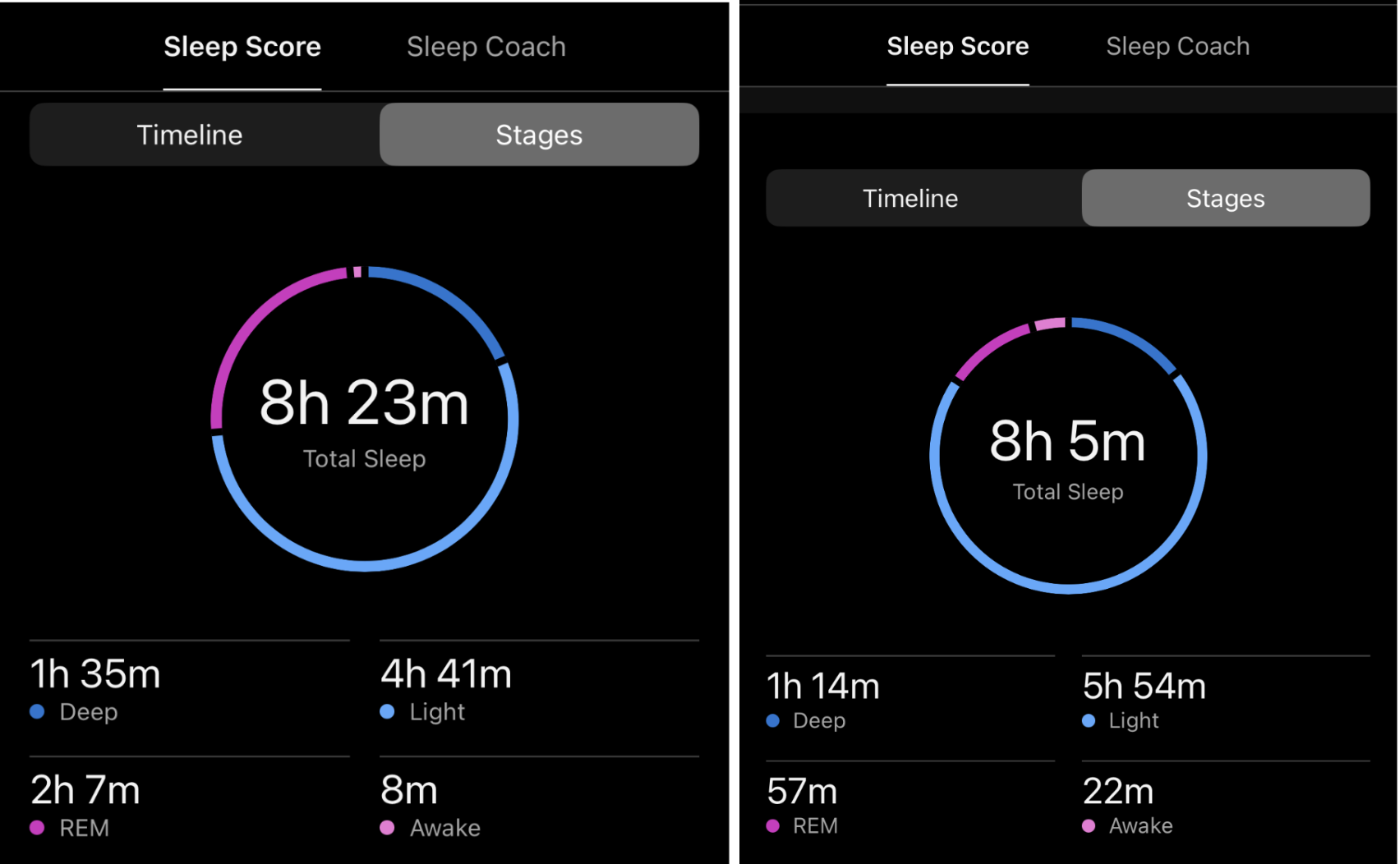
The image on the left shows my sleep stages after a night without alcohol, while the right reflects the impact of just two glasses of wine. Despite sleeping for a similar amount of time, my REM sleep dropped from 2.7 hours to just 57 minutes—highlighting how even small amounts of alcohol can significantly disrupt restorative sleep.
Power Down Before Bed: The Digital Detox and Circadian Rhythm Connection
In today’s hyper-connected world, one of the biggest barriers to restful sleep is our relationship with technology. The glow of screens, the endless stream of notifications, and the anxiety-inducing content we consume just before bed conspire to keep us awake longer, disrupt our sleep quality, and throw our natural rhythms out of sync.
To understand why this happens, we need to look at the role of circadian rhythms—our body’s internal clock that governs the sleep-wake cycle. This 24-hour cycle is controlled by the suprachiasmatic nucleus (SCN), a master clock in the brain that relies on environmental cues, particularly light, to stay in sync. Exposure to natural light in the morning signals the brain to suppress melatonin production, keeping us alert and awake. As evening falls and light fades, melatonin levels naturally rise, helping us wind down and prepare for sleep.
But when we introduce artificial light, especially the blue light emitted by phones, tablets, and laptops, late into the night, we confuse this delicate system. Our brains interpret the blue light as a signal that it’s still daytime, delaying melatonin production and pushing our sleep cycle out of alignment.
It’s not just the light that’s the problem. Scrolling through social media, checking emails, or consuming anxiety-inducing news can also trigger anticipatory anxiety, a state of mental hyperactivity that prevents us from fully relaxing. This shallow, restless state of mind leaves us tossing and turning, unable to achieve the deep, restorative sleep we need.
For some people, the effects of late-night screen use can be even more pronounced. Those with high impulsivity or neuroticism may find it harder to resist the temptation of “just one more scroll” or “just one more episode,” leading to prolonged screen time and reinforcing a cycle of fatigue and overstimulation.
An Invitation: 3 Ways to Instantly Improve Sleep Quality
Improving sleep quality is essential for overall well-being, and even small changes can make a big difference. Here are three tips to help you sleep better tonight:
Digital Detox: Power down your devices and limit social media or email engagement at least 1 hour before bed. This period of screen-free time signals to your internal clock that it’s time to prepare for rest, helping to regulate melatonin production and align your circadian rhythms.
Sleep regularity: Pair your digital detox with going to bed and waking up at the same time every day, even on weekends, and you create the perfect conditions for more restorative sleep. Regularity helps synchronize your body’s internal clock, ensuring you feel rested and rejuvenated rather than groggy and out of sync.
Sleep Stories or Books: Keep a good novel or audiobook by your bedside. Apps like Calm also offer sleep stories that can help quiet your mind.
Lights Out: Give your mind the time it needs to unwind by dimming or turning off bright lights an hour before bed, and keep your bedroom cool (around 20°C). Your sleep and your body will thank you.
For more in-depth insights, I highly recommend listening to the Diary of a CEO episode with Dr. Matthew Walker.
What are you doing to tack Rough_North for better sleep? Let’s start a conversation about how we can all reclaim the power of rest. Share your experience in the comments below or with someone close to you.